
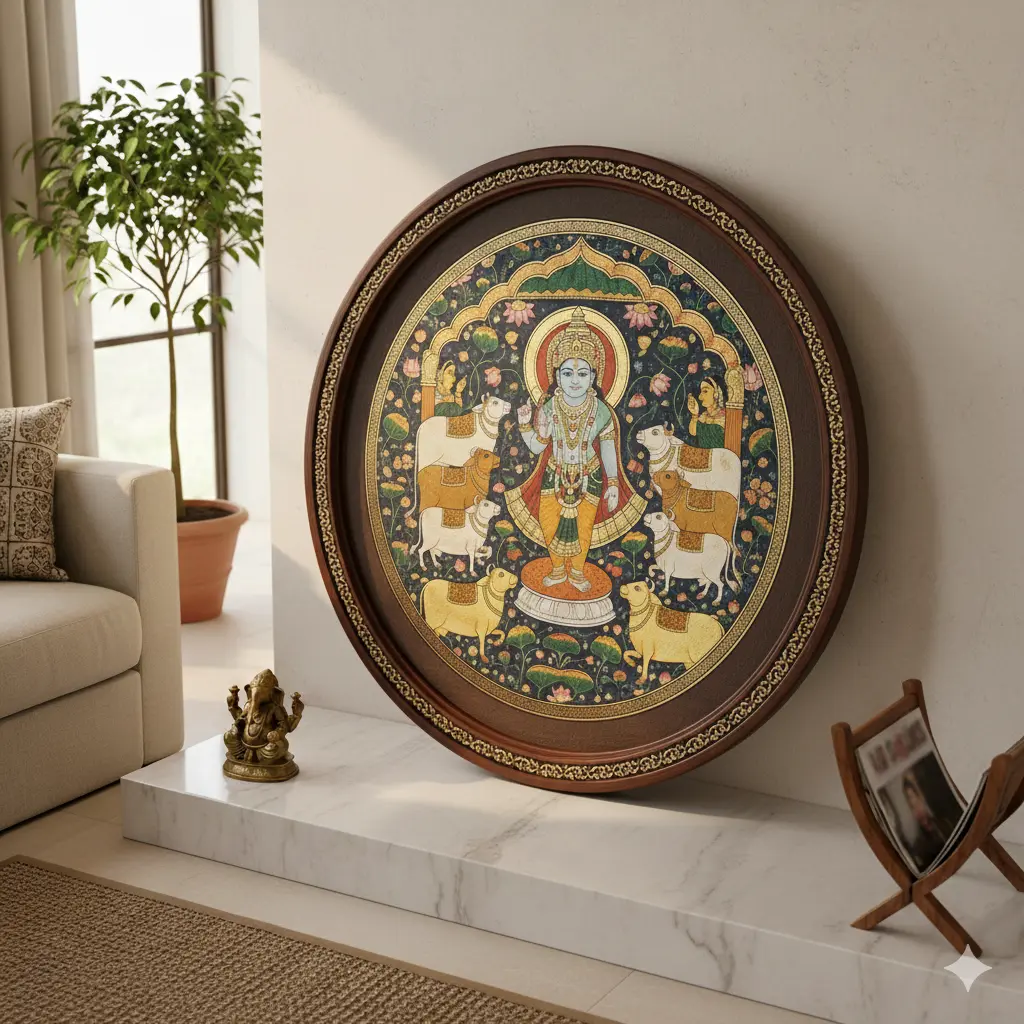
Pichwai art is not just a form of decoration; it is a 400-year-old legacy that breathes life into Indian heritage. This tradition began in the 17th century, and its historical journey from temple shrines to modern homes is well-documented in the Pichwai Art Wikipedia article. If you are looking to elevate your home with something that speaks of luxury, spirituality, and history, a Pichwai painting is the ultimate choice. In this comprehensive guide, we will explore the roots, the symbolism, and the modern-day relevance of this magnificent Rajasthani art form.
The Divine Origin and Historical Evolution
The word “Pichwai” is derived from the Sanskrit words ‘Pich’ (back) and ‘Wai’ (hanging). Historically, these were large fabric hangings used as backdrops for the deity Shrinathji (a 7-year-old manifestation of Lord Krishna) in the temples of Nathdwara, Rajasthan. This tradition began in the 17th century when the idol of Shrinathji was moved to Rajasthan to protect it from the iconoclastic policies of the Mughal era. The Pushtimarg sect, founded by Shri Vallabhacharya, played a crucial role in nurturing this art form.
Every Pichwai painting was originally designed to change with the daily rituals of the temple. Depending on the time of day, the season, or the festival, a different Pichwai painting would be hung. For instance, a painting with lotuses would be used in summer to signify coolness, while a painting with cows and greenery would represent the monsoon. Over the centuries, the art form evolved from being purely religious to a decorative marvel that collectors across the globe now cherish. Today, the Pichwai painting has traveled from temple shrines to high-end luxury apartments in Mumbai, Delhi, London, and New York.
The Craftsmanship: How an Authentic Piece is Created
Creating a Pichwai painting is a labor-intensive process that requires months of dedication. The artists, many of whom belong to the Jangid or Adi Gaur communities, use hand-spun cotton cloth which is first treated with a starch paste made from tamarind seeds. This ensures that the fabric is stiff enough to hold the weight of the natural pigments and prevents the ink from bleeding.
Once the surface is ready, the artist sketches the initial design using charcoal or red lead. The colors used in an authentic Pichwai painting are entirely natural. They are derived from minerals, stones, and even real gold and silver. For example, blue comes from lapis lazuli, green from malachite, and yellow from orpiment. The application of 24K gold leaf, known as ‘Sunehri’ work, is what gives a premium Pichwai painting its radiant glow. This use of natural elements ensures that the painting does not fade for decades, often becoming more beautiful with age as the natural pigments oxidize slightly.
The Different Styles: Nathdwara vs. Jaipur vs. Deccan
Not every Pichwai painting looks the same. The “Nathdwara Style” is the most famous, characterized by vibrant colors, large almond-shaped eyes of Shrinathji, and a focus on daily temple rituals. However, the “Jaipur Style” often incorporates more delicate detailing and a heavy use of gold foil. There is also a “Deccan Style” influence found in some older pieces, which features softer color palettes and Mughal-inspired floral borders. Understanding these nuances helps a collector appreciate the true value of a Pichwai painting.
Why the Pichwai Painting is Trending in 2026 Home Decor
In the fast-paced world of 2026, homeowners are moving away from mass-produced plastic decor and returning to “Soulful Art.” A Pichwai painting offers a unique blend of vibrant colors and intricate details that machine prints simply cannot replicate. Cultural home styling is a major trend this year, where people want their homes to tell a story.
Luxury interior designers are now using these paintings as focal points in modern homes. A large-scale Pichwai painting can act as a bridge between minimalist modern architecture and the rich traditional soul of India. Whether it is a grand villa or a compact urban apartment, the spiritual vibrance of “Krishna Leela” depicted in these artworks brings a sense of peace and divinity to the living space. In 2026, we see a shift towards “maximalist” walls where a single, grand Pichwai painting replaces multiple smaller frames, creating a regal atmosphere.
Symbolism and Motifs: Decoding the Visual Language
Every element in a Pichwai painting has a deep symbolic meaning rooted in Indian mythology. To truly appreciate the art, one must understand its visual language:
The Lotus (Kamal): Symbolizes purity and spiritual awakening. A Lotus-themed Pichwai painting is often used in summers to signify the coolness of the Yamuna river. The sight of blooming lotuses surrounding the deity is meant to provide a soothing atmosphere.
The Cow (Kamadhenu): Represents abundance, prosperity, and the nurturing nature of Mother Earth. Since Lord Krishna was a cowherd (Gopala), the cow is a central figure in almost every Pichwai painting. The way a cow is painted—often gazing lovingly at Krishna—represents the ‘Bhakti’ (devotion) of the soul.
The Peacock: Signifies grace, beauty, and the arrival of the monsoon. The dance of the peacocks is often used to depict the joy of the gopis and the nature in the presence of Krishna. In a Pichwai painting, the peacock’s feathers are often detailed with real gold or silver.
The Tree of Life: Represents the connection between the heavens and the earth. The Kadamba tree is particularly sacred in this art form as it was Krishna’s favorite tree, under which he played his flute.
Vastu Importance of Sacred Indian Art
According to Vastu Shastra, placing sacred art in the right direction can attract positive energy and ward off negativity. A Pichwai painting featuring Lord Krishna or cows is considered highly auspicious for domestic happiness and financial stability.
East Wall: Placing a Pichwai painting on the East wall promotes health, social harmony, and recognition. It is the direction of the rising sun, and the vibrant colors of the art resonate well with this solar energy.
North-East (Ishan Corner): This is the most spiritual zone of the house. A Pichwai painting here helps in meditation, brings divine blessings, and enhances the wisdom of the inhabitants. Many families choose to hang a Shrinathji Pichwai painting in their ‘Mandir’ area or meditation room.
South-West Wall: Some experts suggest that a Pichwai painting showing the ‘Govardhan Leela’ (where Krishna lifts the mountain) is best placed in the South-West to provide stability and protection to the family.
Seasonal Themes in Pichwai Art
A unique aspect of the Pichwai painting is its seasonal relevance. In the temple, the paintings are changed according to the Hindu calendar:
Sharad Purnima: This theme depicts the ‘Ras Leela’ under a full moon. The Pichwai painting is usually white or silver, showing Krishna dancing with the gopis.
Annakoot: This represents the offering of 56 types of food (Chappan Bhog) to Shrinathji. A Pichwai painting with this theme is filled with details of various delicacies.
Janmashtami: Celebrating the birth of Krishna, these paintings are often very festive, showing the infant Krishna (Bal Gopal) in a cradle or being carried across the Yamuna.
Sandhya Aarti: Capturing the beauty of the evening ritual, these paintings use darker, deeper tones of blue and orange to represent the twilight.
Modern Adaptations: Canvas, Paper, and Beyond
While the traditional art was done on cloth, modern versions vary based on the medium and technique to suit different budgets and tastes:
- Cotton Fabric Pichwai: The most traditional and sought-after form for serious collectors.
- Paper Pichwai: Detailed miniature versions of a Pichwai painting suitable for small desk frames and gifts.
- Canvas Pichwai: A modern adaptation that is easier to frame, transport, and maintain in urban homes. Many artists at Sigma Handicraft now use canvas to ensure that the Pichwai painting survives harsh weather conditions and humidity.
- Embroidered Pichwai: Some regions create these using Zardozi or Gota-Patti work, adding a 3D texture to the artwork.
How to Identify and Buy Authentic Art
As a buyer in the digital age, you must be careful not to buy a cheap digital print disguised as original art. A real Pichwai painting has certain characteristics that are hard to fake:
Hand-painted imperfections: Since it’s made by hand, you might see slight variations in lines or brushstrokes. In a real Pichwai painting, no two faces of the cows or gopis are exactly identical. Texture of colors: Natural stone pigments have a slightly grainy, matte feel compared to the flat, glossy, or plastic finish of digital ink. The Gold Work: If you tilt the painting, real gold leaf in a Pichwai painting will have a distinct, soft shimmer rather than a harsh, metallic glitter. The Smell: Traditional paintings often have a faint earthy smell due to the natural binders like ‘Gond’ (gum) and natural pigments.
Buying from a trusted shop like Sigma Handicraft ensures you get authentic artisan-made products that support the local economy of Rajasthan.
Caring for Your Investment
A high-quality Pichwai painting is an investment that can last for generations if cared for properly. Because it uses natural fabric and minerals, it is sensitive to the environment:
Framing: Always use high-quality glass framing (non-reflective museum glass is best) to protect the fabric from dust, moisture, and pests. Ensure there is a small gap (spacer) between the glass and the Pichwai painting so the fabric can breathe. Avoid Sunlight: While the colors are natural, constant direct sunlight over decades can lead to some fading. Place your Pichwai painting on a wall that receives ambient or indirect light. No Moisture: Humidity is the enemy of fabric art. Ensure the wall where you hang the painting does not have any dampness or seepage. If you live in a coastal area, using a dehumidifier in the room can protect your Pichwai painting.
The Economic Impact and Artisan Support
By purchasing a Pichwai painting, you are directly contributing to the survival of a traditional skill. Many artisan families in Nathdwara have been practicing this art for ten generations. In a world dominated by AI and machines, the human touch of a Pichwai painting reminds us of the value of patience and skill.
The ‘Guru-Shishya’ tradition is still alive in this art form, where a master artist (Usta) teaches the nuances to young apprentices. At Sigma Handicraft, we pride ourselves on sourcing directly from these craftsmen, ensuring they receive a fair price for their incredible talent. Each Pichwai painting you buy helps keep the fire of Indian tradition burning and provides a livelihood to hundreds of families.
Today, the Indian handicraft sector is supported by the Ministry of Textiles, Government of India, which helps preserve traditional arts like the Pichwai painting for future generations.
The Future of Pichwai Art: A Global Perspective
In 2026, the Pichwai painting has transcended its religious roots to become a global art phenomenon. Museums in the US and Europe are holding exhibitions dedicated to these “Tapestries of Devotion.” The global art market has recognized the Pichwai painting as a high-value category, often auctioned alongside contemporary masters. For an Indian homeowner, having a Pichwai painting is a way to stay connected to their roots while showcasing a sophisticated, global aesthetic.
Detailed Step-by-Step Production Process
- Selection of Fabric: Artists choose between khadi, cotton, or silk.
- Treatment: Applying a mixture of glue and chalk.
- Sketching: Red lead or charcoal is used for the rough draft.
- Color Filling: The background is filled first, followed by the main figures.
- Shading and Detailing: Adding depth to the eyes, hair, and clothing.
- Gold Work: The final stage where gold leaf is applied to ornaments.
- Polishing: Rubbing the painting with a smooth stone to give it a finished look.
A single large Pichwai painting can take anywhere from 3 weeks to 6 months depending on the level of detail and the number of figures involved.
Most Searched Queries and Trends
If you are looking to buy or learn more, here are the trending search terms in the world of Indian art: “Pichwai painting online India”, “Krishna wall art”, “Shrinathji Pichwai”, “Lotus Pichwai decor”, “handmade Rajasthani paintings”, “Vastu for Pichwai”, “buy traditional Indian art”, “luxury home decor items”, “Sigma Handicraft Pichwai”.
A Timeless Treasure for Every Home
In conclusion, a Pichwai painting is much more than just a decorative piece; it is a spiritual anchor and a cultural statement. It connects you to the ancient traditions of Rajasthan while adding a layer of sophistication to your modern home. It is a piece of art that tells a story of love, devotion, and nature’s beauty. Whether you choose a small paper miniature or a massive fabric masterpiece, a Pichwai painting will remain a timeless treasure that continues to inspire awe and devotion for years to come.
Explore the curated collection at Sigma Handicraft today and bring home a piece of eternity.